Turning Failure into Something Useful
I’m writing a book about what my 2025 race season taught me. Here’s the draft intro, and I’d love your help improving it

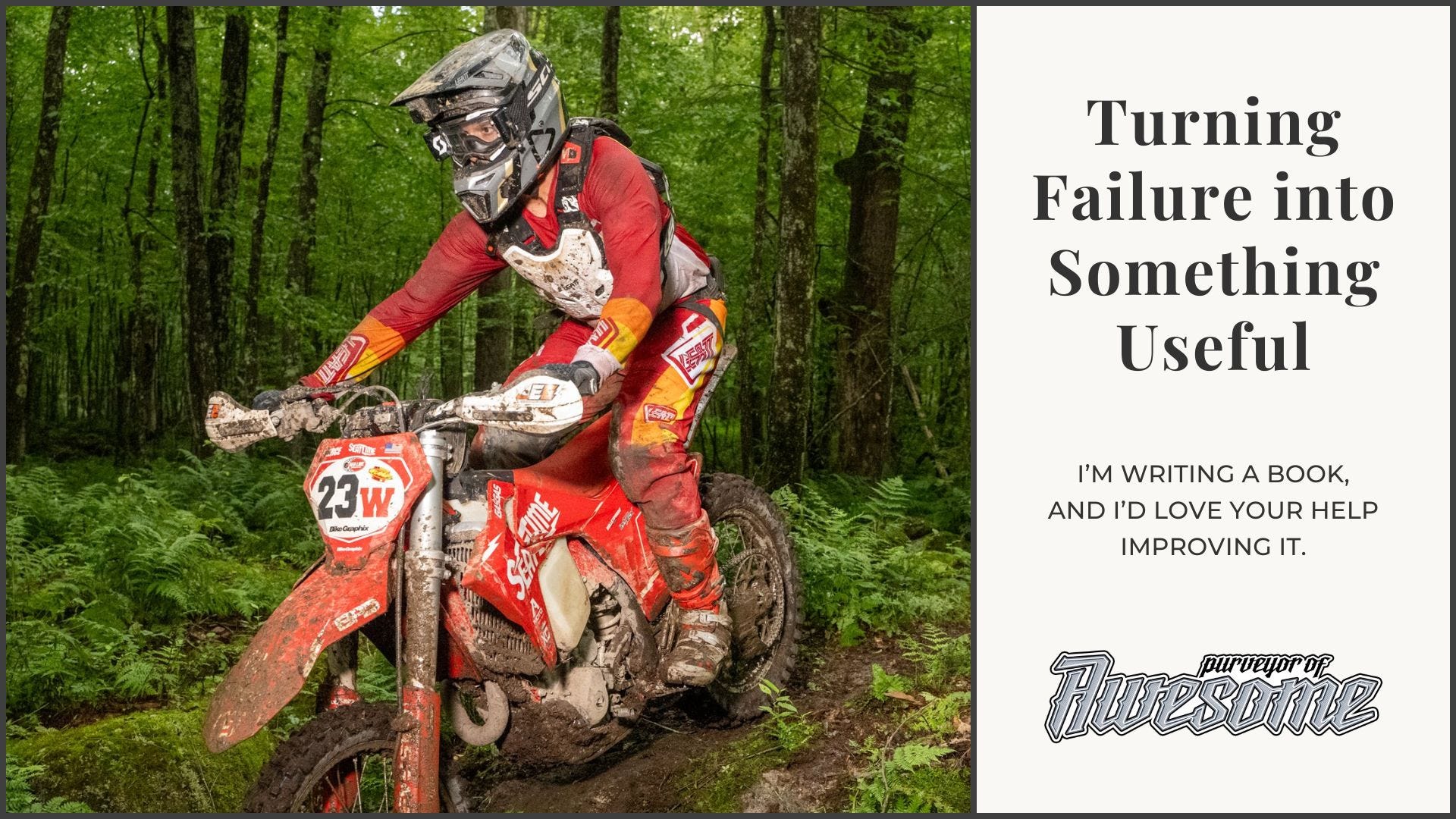
As the subtitle above says, I am writing a book. I want this book to be an experience for the reader. I want them, and you, to be taken on the road and trails my 2025 race season took me on. I hope you feel the growth from failure I found as I break down every mishap to turn them into a learning experience. Within this story, you’ll also learn a bit about dirt bikes and the dirt bike community. I have spent my entire life within this community thanks to my dad, Stephen Pierce, and I want to celebrate that.
Before you jump into the book intro that I have written, I wanted to say thank you for being here. If anything below confuses you, should be expanded upon, or thought about differently, please leave those thoughts and/or notes as a comment to this post. Not only will that help me, but the engagement on the post itself in the form of comments can help it’s reach within Substack. Yes, that matters.
Thanks again, and here’s the introduction to the book. The work in progress title is Growth from Failure.
Book Introduction
As I took the left hand turn, I saw the sapling crossing the trail. I could tell it was slick, and that it was at the perfect angle to cause havoc. If I didn’t get the front wheel off the ground to clear the 2 inch thick downed tree, I was going down. Instead of letting years of built up experience take over, I panicked. I slammed on the brakes, trying to stop my forward momentum before it was too late. What happened next is what any experienced rider knows happens when your front tire plows into a slick, angled obstacle on the trail. The front wheel follows the obstacle, not the trail, causing the front of the bike to tuck and get “washed out” (what we say when the front wheel is removed from underneath a rider).
As the pull of gravity took over due to the front wheel being washed out, I reached a new level of pissed, an anger I hadn’t felt in a long time. Since the bike went to the left of the trail, I was thrown off to the right. I jumped up quickly, but my anger had hit the boiling point. I released a guttural scream into the air, curse words flying from my mouth because I couldn’t keep my rage inside any more.
As I picked the bike up, I began to berate myself. Not only did I question what the hell I was doing attempting to race this National Enduro, but I began to question my ability to show up in life at all. My confidence in myself was completely shattered. All of these thoughts escalated quickly, but I still had to move forward, because no one was coming to get me out of the woods. That was on me.
The front end of the bike was twisted and the brake lever was pointing toward the sky. The front end would have to wait though because I knew the brake lever had to get back into a usable location for the miles ahead to finish the second to last test section.
This type of mental lapse is what makes or breaks a racers day. Mistakes happen all the time in racing, as in life. We should be able to mentally clean the slate and move forward. It’s when we can’t let the mistake go, and we allow the moment to stay with us that allows frustration to compound. As we circulate on the mistake, more mistakes happen because we’re less focused on the task at hand. As more mistakes happen, they begin to weigh us down past the original incident. I’d spend the better part of 2025 chasing that awareness, and it started long before I ever ended up on the ground in Pennsylvania.
It’s strange to look back on this moment from the 2025 National Enduro Series, because I now know that was the moment I learned I didn’t have my emotions under control. Though I have had years up to this point where I have been understanding my anger more, I still couldn’t fathom where this pain and disappointment was coming from. This was the moment in my 2025 race season where I realized I wasn’t the racer I thought I was. It was the moment where I looked in the mirror and realized I had a lot of growing to do if I wanted to become the racer I knew I could be.
I believe there are a lot of other people who are in a similar situation as I was in the woods of Pennsylvania. Though you may not be laying face down in the woods after a dirt bike crash, I believe others can feel stuck and angry, as if they’re letting themselves down. I believe the growth I found from this one moment, and the many more we’ll discuss in this book, can be enlightening and helpful. You as the reader will get a chance to learn about me and my passions, while I try to find a way to relate my learnings in a way that you can leverage as well.
What I hope for you as a reader is that you enjoy an experience, while finding a few moments of reflection and growth as I bounce back from my failures and enjoy my successes. I am going to take you with me on the road and into the woods as I compete in the 2025 National Enduro Series at the ripe age of 46. The National Enduro Series is the highest level of enduro racing in the country, and while it draws professional riders, it also opens the course to amateur competitors like me. I raced in the A45 class, which is the Expert level class for riders 45 to 49. We ride the same trails on the same day as the pros. I am not a professional racer. I am a 46-year-old amateur who decided to finally commit to racing the full season of National Enduros. For this year, the series was eight races spanning from February to November. I also sprinkled in a few local events to keep sharpening my skills.
Most of the events we’ll break down are called Enduros. They are full days in the woods on a dirt bike, covering a minimum of 45 miles of trails across six timed test sections. Think of each test section as a sprint through the woods where the clock is running and every second counts. Between those sections, you’re transferring to the start of the next test section, managing your bike, body, and mind, and knowing there’s still more to come. At the end of the day, your six section times are added together, and the lowest score wins. Fastest total time takes the win.
Though the purpose of this book is not to highlight my results, we’ll discuss them because those results showcase the changes I made as a rider and racer showing up in competition. There is a lot that can be learned from success, which we do not want to ignore.
The weaknesses though are very obvious if you’re willing to look. Due to my desire to become the best racer I could by the end of the year, I was always breaking down a race for what I could do better or learn from. From those moments, we’ll dig into the weaknesses I find and how I made them less of a weakness.
Even though you didn’t drive the 15,000+ miles with me in 2025 to get to and from all the races, I’m glad you’re here now. The race year starts in Sumter, South Carolina at the Sumter National Enduro. A race my ego told me I was prepared for, but the reality of the situation is that I was overly confident and under prepared. Let’s start the drive.
Thanks for making it this far.
Please leave any feelings, thoughts, or critiques as a comment below so I can try to help as many people with my learnings as possible. If there’s someone to share this with, please do so.
Between the introduction and the first chapter, I am also going to have a light explainer about how to find more information on the races and the recaps that support the previous chapter. I want readers to know they can see the action if they choose to go deeper. The plan is to add links, or QR Codes, to the end of each chapter so readers who do want more can easily access it. After that one pager explainer, we’ll dive into Chapter One, which covers Round 1 in Sumter, South Carolina.
If you’re not subscribed to Purveyor of Awesome, please do so. There will be future chapters to get your feedback on, as well as other writings of mine as they bubble to the surface.