A Rough Start
This is version three of where my learnings from 2025 started. I’d love your help making sure Chapter One balances the story and the takeaways.

I’ve had a whole host of learnings while trying to nail down this chapter. Even though I don’t think it’s “print worthy”, it’s come a long way from where it started. At times I wrote very technically, while other times I rambled on. I believe this is a nice middle ground, so readers have just enough dirt bike context to understand my failures and apply the learnings to their own life.
That’s where I’d like your help. When you read this, please let me know what this chapter might be missing or where you get lost. I also have some thoughts on a work-in-progress title for the chapter, but I’ll share those afterwards.
Thanks for taking the time to read what I’ve crafted so far. I appreciate it.
Chapter One
A Rough Start
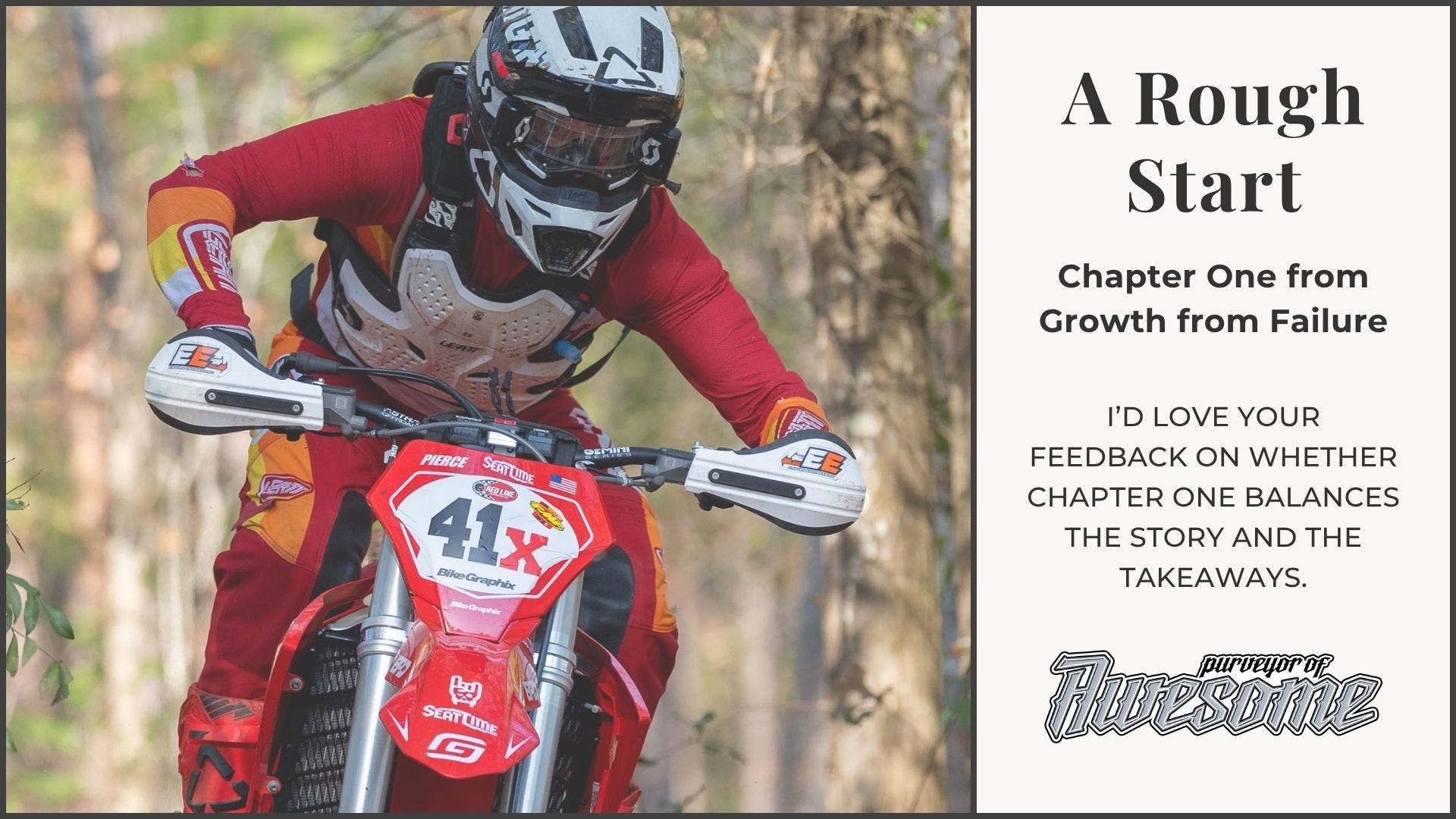
When I lined up with the 6 other racers on my row to start the Sumter National Enduro, I had high hopes of a decent ride and result. I had just spent the entire 2024 season racing and training to see how decent of an enduro racer I could become. I progressed a ton during that previous year, and even though I was on a new bike, at a new property and many miles from home, I thought I was ready to attack the Sumter trails; I was wrong.
My mistakes coming into Sumter were more than an inflated sense of my abilities. My mistakes also stemmed from a misunderstanding of the machine I was racing.
As the faster racers from my row began to ride away from me, I tried to take the pull. As a racer following other racers, the trail is inherently blocked by their bike and body. Due to this inability to read the terrain and trail, you try to key off the bike and body position for what the terrain is doing and where the trail is going. Think of this like driving down the interstate with semi-trucks blocking your forward vision, and trees on either side blocking your peripheral vision. You either choose to slow down so you can see what’s in front of you, or you trust the semi-trucks speed and direction and follow their chosen path.
As we started to spread out from each other, we hit the first set of deep whoops. Think of whoops like the quick up and down section of a rollercoaster. The fastest way to ride them is called “skimming the whoops”. The goal here is to try to ride the tops of the whoops, never letting the bike drop down into the lower part between the tops. This is a skilled technique that looks and feels awesome when you pull it off. I did the opposite of looking cool and skilled.
Due to the accumulated years of dirt bikes that have ridden through the Sumter trails, the whoops are extremely deep in the South Carolina trees. As the riders I was still keeping up with charged another set of whoops, my front end dropped into the bottom of a whoop, which sent me bouncing off into the woods. Though I didn’t smack a tree this time, my butt puckered so hard that my back hurt, because this scared the crap out of me. This was my first feeling of “this is different”.
The next mistake I made was a few miles further down the trail while threading through a tighter section of trees. My front end felt extremely twitchy, which I should have taken as a sign to ride a tad slower. This twitchy feeling comes from too much weight on the front wheel of the motorcycle. The goal with a bike’s suspension setup is to find a balance for the bike with a rider’s weight and style of riding. Unfortunately for me, I tried pushing harder and faster than I should have on a bike we hadn’t set up properly yet.
I was pushing myself because I was now riding alone in the woods, having been dropped by the faster riders from my row. This created a sense of urgency in me, like I needed to try and catch up, even though they were obviously much better riders than I was. This determination had me pushing for faster than I was physically capable of.
As I rolled through more whoops that were mixed in-between a tighter tree section, the trail swerved and I clipped one of the closer trees. This created a pinball effect of me bouncing off multiple trees as I tried to stay upright. Ultimately, I hit one of the trees so hard it stopped me in my tracks. Once I picked the bike up off the ground, my front brake lever, which is on the right side of the bike, was pointing straight up. Being that this awkward lever positioning wouldn’t allow me to ride the bike at all, I stopped to get my tools from my buttpack. When you’re attempting to ride a section of trail at your fastest pace, stopping to reset your levers from a crash works against you setting a fast time.
As I was fixing the front brake lever, I felt rushed, but I also felt deflated, almost angry with myself. This wasn’t how I saw the day going. When I started the drive to South Carolina two days earlier, I didn’t see myself crashing in the first test section and fixing my bike on the side of the trail.
What I didn’t realize yet, was that underneath the frustration was something else; I was scared. Scared that I had allowed my ego to write a story about my abilities that simply wasn’t true. And I had hung my performance and results on that story when I showed up at Sumter.
I finished this first test section 516th Overall and 20th in the 45A class. Considering I see myself as someone who should always be in the Top 100 at a National Enduro, if not pushing to get into the Top 75, 516th was an utter failure. After I finally finished test one and rode my way to the start of the second test section, I had to lick my wounds a little bit.
At that moment, sitting on the bike waiting for the next test section to begin, I knew I had to reset mentally. If I allowed this feeling to stay with me the rest of the day, not only would I ride poorly, but I wouldn’t even have any fun. I was able to turn it around a little bit in the second test section, riding out 258th overall and & 9th in the 45A class.
As the race day at the Sumter Enduro continued, I kept progressing my speed and my comfortability on the bike. This resulted in some pretty distinct learnings and successes to take away from the day. Looking at your successes is a great way to find clues that you can leverage for future events, races, or performances.
The first success was during the third of six tests, about halfway through the race. I started riding a gear higher on the GasGas, which has a six speed transmission. This means that in terrain I may normally be in second gear, I upshifted to third. If I would normally ride in third gear, I would upshift to fourth.
I did this because the bike felt very unstable during the early test sections. In the lower gears, I had to ride the bike at higher rpm’s, so the engine was vibrating more. When I began riding the bike a gear higher in the third test section, the RPM’s were lower, so the engine vibrated less.
I learned that by riding a gear higher, with lower RPM’s, the bike’s suspension would work better and I could charge harder on the bike. This feeling was a successful learning because I was able to make gearing changes to the bike after Sumter to ride like this moving forward.
The second success was during the final test section of the day. We were five hours into a race day that became much warmer than expected. Due to that, riders didn’t have their hydration and nutrition strategy planned out for the warmer temperatures. My nutrition journey is an entire other book, but I was very prepared for the necessary hydration and nutrition to ride hard all day long. So as some riders were barely hanging on to their bike riding to the start of the last test section, I was energized and ready to attack. The way I rode, and my results in that last test section, showcase the stamina I had on the day, and the growth found from riding the bike differently.
Test one, where everything felt like it fell apart, I was 516th Overall and 20th in the 45A class. Test six, which was the last test section on the day, I was 104th overall and 4th in the 45A class. As all the test section scores came together, I finished 7th in the A45 class and 156th Overall. One thing I recognized quickly from looking at all the Expert Age Class scores was that there were a lot of fast old dudes. That’s damn inspiring and I was excited to start putting in the work to try and challenge them.
As I started the ~2,000 mile drive home I began to reflect on the day. The failures I had were the glaring holes that I needed to work on. Knowing that these “holes in my game” needed to be filled in, they gave me the building blocks for the next few weeks of training and bike setup. The successes on the day were the clues toward what was working. These were areas to stay consistent, knowing they may need attention, but for now, they were where they needed to be.
I approached it like this because success gives us clues and failure gives us answers. When you succeed at something, there are few times that one single action creates the success. Because of that, it can be hard to pinpoint what exactly causes you to succeed. When we fail, it’s easier to break down and find the reason, or reasons, that caused failure. These answers to why we failed are what we need to adjust and pivot so we can create future success.
Even though I was way off where I thought I would be, I didn’t let it hold me back from trying to get to where I knew I could be. I leveraged my long drive home to get started on growing from my Sumter failures. I texted Brian Storrie, the coach that I worked with as soon as the new bike arrived, to set up time for us to come back to bike setup. I reflected a lot on what worked in 2024 that didn’t work so far in 2025. I also called my Dad.
My Dad is the one who started me on a dirt bike at the age of five. He’s seen me ride really slow, and he’s also seen me progress as a rider as I’ve gotten older. Due to this time together on two wheels, we’ve chatted a lot about riding and racing over the years. I knew a chat with him would be a good way to get everything off my chest. As well, I cleared the air with a few other friends of mine who I knew I needed to vent to, but would also hold me accountable for what I had control over.
As I spent more time reflecting on the entirety of the season while thinking I might write this book, the learnings from Sumter, and the way I applied them, became more solidified. I realized I wasn’t just a dirt bike racer trying to ride faster. I was a human who was trying to process. In these post-2025 reflections, I learned a few more words to put toward the things I was learning about myself.
What I was experiencing in the first of six test sections on the day at the Sumter Enduro was a lack of experience. I was Unconsciously Incompetent.
Unconscious Incompetence essentially means “you don’t know what you don’t know”, and it is the first stage of the four stages of competence. The years of experience I have racing dirt bikes lead me to believe I knew what I was getting myself into by racing the Sumter Enduro. The truth is the new dirt bike I was riding, and the new terrain and trails I was competing on, left me completely unknowing as to how I should prepare.
The more interesting part now that I look back on this adventure was I believed I knew what I was getting myself into. I knew that switching from the bike I was racing on in 2024 was going to be a difficult switch to the bike I was going to race in 2025. So much so that I worked with a coach, Brian Storrie, to try and get the bike, body & mind as prepared as possible. I believed the effort we put toward that setup was enough to prepare me for the first race of the 2025 National Enduro Series; As I was straightening my brake lever in that first test section, the realization of how ignorant I was to the task at hand was setting in.
As I started learning about these four stages of competence, I thought I was starting the 2025 season at the second stage of competence, which is Consciously Incompetent. This stage breaks down to “I know there is a gap in my knowledge and mistakes will be made”. I believed working with Brian on bike setup and preparing my body and mind with training was going to be enough to even out what I would learn on the fly. As it turns out, I wasn’t as adaptable as I thought.
The last two stages in the four stages of competence are Conscious Competence and Unconscious Competence. Though it took me an entire season of racing to work my way through these later stages of competence, I was able to get there. The most rewarding feeling of all of this journey is looking back on the last few races where I was finally able to let go.
I reached moments of unconscious competence, or a flow state, where there were no thoughts to what I was doing, there was only the intimate knowledge of the task at hand, which was to attempt to ride my dirt bike really fast in the woods. We’ll discuss those more in-depth when it’s time.
I know now that when I lined up at the start of the Sumter Enduro I was misaligned. I allowed my ego to inflate itself so that I believed I was more prepared than I actually was. I was imposing a 2024 belief on myself that had no evidence in this 2025 reality. I was ignorant of the speed of the other racers, the technical nature of the new courses, and the growth I still needed on the new bike. If you’re looking for descriptive words to use here, cocky and arrogant come to mind.
I do not believe I was cocky or arrogant directly towards other racers, but I let previous outcomes over-inflate my true status as a racer and competitor. This created a deflating effect after the fact because I didn’t live up to a predetermined outcome I had imagined for myself.
I believe one can earn their ego through the work put in toward the person they want to become. Though results may help guide you toward the right path for your desired goal, you don’t build confidence in yourself based wholly off results. It’s about who you want to see yourself as, not who you want others to see you as.
On the drive home from Sumter I had to figure out how to accept that the day hadn’t gone the way I thought it would. The words “unconscious incompetence” weren’t even in my vocabulary yet, let alone the perspective to see how blind I had been to what I didn’t know. I felt like I had let myself down, and that my riding didn’t live up to my own expectations. If any part of that feels familiar to you at some point in your life, you’re not alone. Reflecting on the Sumter Enduro is just the first dive into what it means to discover we’re not as far along as we thought. What we choose to do with that knowledge is where growth starts.
Summary
“You don’t know what you don’t know”
Every rider or competitor is a human first, and due to this we have the ability to be ignorant. Ignorance is just “lack of knowledge or information”. This awareness of a lack of knowledge is a good problem to have. It allows us to accept that we don’t know everything and opens the door to learn, grow, evolve, and adapt.
Be honest with yourself about why you don’t have the thing you desire to have. If there is something you’re ignoring on purpose, because it’s hard to accept, that’s probably where you need to lean in the most. Don’t let your ego hold you back.
Earned Ego vs Inflated Ego
An “Earned Ego” is found in someone who is Confident, Steady, or Realistic. They understand that the work they put in & achievement they receive provides evidence of their capabilities. This allows you to constantly build upon the belief in yourself.
A “Self-Inflated Ego” is found in someone who is Cocky, Arrogant, or Exaggerated. They imposed their desired beliefs about themselves on others without evidence. This forced belief crumbles as they can’t build upon a belief in themself that doesn’t exist.
To “earn your ego”, you put the work in toward the person that you want to become. You can’t rely on results, or outputs, alone to gain confidence. It’s about who you want to see yourself as, not who you want others to see you as. If you’re doing this for external validation, it’ll feel hollow & undeserved. If you’re doing this for your personal growth, it’ll be rewarding & fruitful.
Failure gives us answers. Success gives us clues.
The growth from failure I found was blatantly obvious, but that might not be for you. If you feel you are failing, ask yourself why. It may be uncomfortable, but the more you do it the more normal it becomes. As you get better at digging into the why, the quicker they surface. Which means the quicker you can begin working on them.
Successes can be just as helpful as failures, though they may not be as obvious. If I only judged my race day at Sumter by my result, it would all feel like a failure. I had to look at smaller parts of the day to realize I had many small wins. You may need to do something similar, breaking down a race or a moment in time into smaller, more manageable chunks. This will allow you to celebrate the small wins, and put a process into place to make sure they stay a strength.
Thanks for making it this far.
Please leave your thoughts, ideas, reflections or critiques below as a comment. As well, here are my work in progress titles. Feel free to respond to those as well, or send through other ideas.
Two titles options for this chapter:
A Rough Start
A Start I Didn’t Expect
I was actually playing around with An Unexpectedly Rough Start, but scrapped it. So let’s say that’s actually a third option.
If you found your way to Chapter One and missed the Introduction, please give that a gander here.
If you’re not subscribed to Purveyor of Awesome, please do so. There will be future chapters to get your feedback on, as well as other writings of mine as they bubble to the surface.